
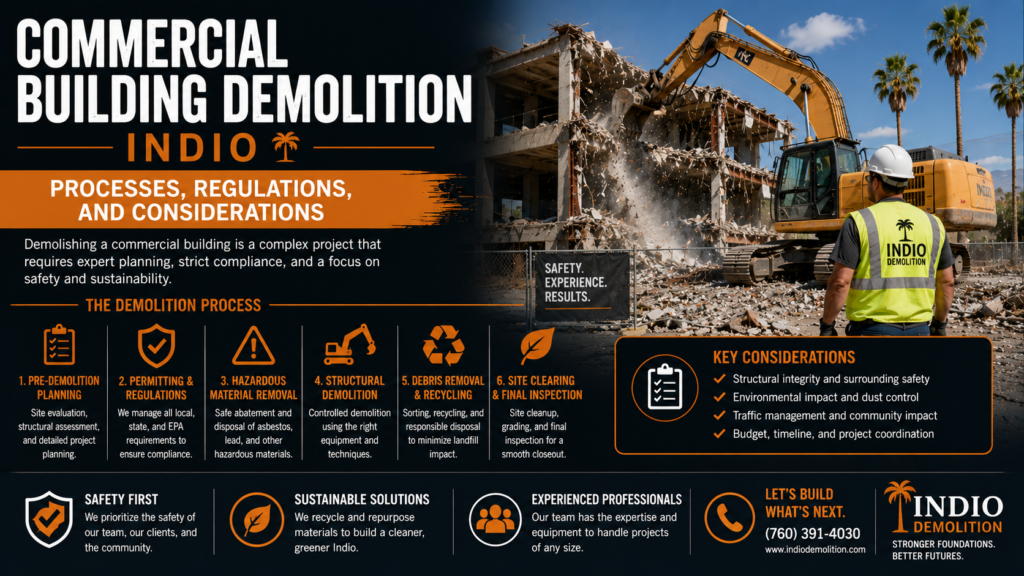
Commercial building demolition is a substantially more complex undertaking than residential teardown. Scale, structural complexity, regulatory requirements, site management, hazardous materials, and coordination with adjacent businesses and public infrastructure all add layers of planning and execution that demand professional expertise. In Indio, California, where commercial development continues to evolve across the city’s growing commercial districts, understanding what Commercial Building Demolition Indio involves is essential for property owners, developers, and businesses planning redevelopment projects.
The Scope of Commercial Demolition
Commercial buildings encompass an enormous range of structures retail strip centers, freestanding restaurants, office buildings, warehouses, industrial facilities, hotels, and mixed-use developments. Each presents different demolition challenges based on its construction type, age, materials, mechanical systems, and site context.
Steel-frame structures require different techniques and sequencing than concrete tilt-up construction, which differs again from wood-frame commercial buildings. Multi-story structures require careful top-down demolition sequencing to maintain structural stability throughout the process. Structures adjacent to operating businesses or public areas require extensive site safety controls to protect people and property during demolition.
These variables mean that commercial building demolition is never a one-size-fits-all process. Each project requires individual assessment, planning, and execution tailored to the specific structure and site conditions.
Regulatory Requirements for Commercial Demolition in California
Commercial demolition in California operates within an extensive regulatory framework. Building permits are required for all commercial demolition California Building Code Section 105.1 is unambiguous that any demolition requires a permit, regardless of structure size or value. In Indio, the building permit review process typically takes ten to twenty days for commercial projects, with more complex projects potentially requiring additional agency coordination.
Asbestos and hazardous materials are a particular focus of commercial demolition regulations. California Health and Safety Code § 19827.5 requires asbestos notifications to appropriate agencies before demolition proceeds. Commercial buildings constructed before the mid-1980s are highly likely to contain asbestos in some form floor tiles, ceiling tiles, spray-applied fireproofing, insulation, roofing materials, and pipe coverings are all common locations. All pipe-covering insulation, ductwork, and steel beam fireproofing must be surveyed for asbestos content before demolition begins, and if asbestos is present, the employer must comply with Section 1529 of the California Code of Regulations.
Utility coordination is another mandatory pre-demolition step. All utility services electricity, natural gas, water, sewer, telecommunications must be properly disconnected and certified before demolition equipment engages the structure. For commercial buildings, which often have complex mechanical and electrical infrastructure, utility disconnection can itself be a significant project. Utility companies must be notified in advance, and documentation of disconnection is typically required as part of the permit process.
Cal/OSHA oversight applies to commercial demolition projects. The California Division of Occupational Safety and Health’s construction safety orders include detailed requirements for demolition operations covering worker protection, structural stability during demolition, debris management, and specialized procedures for multi-story buildings.
Environmental Considerations
Commercial building demolition generates substantial quantities of debris and may involve materials with specific environmental management requirements beyond asbestos. HVAC systems often contain refrigerants that must be recovered by certified technicians before equipment is demolished. Electrical equipment may contain PCBs or other regulated substances. Underground storage tanks, if present, require specialized assessment and management. Petroleum-contaminated soils discovered during demolition trigger separate regulatory pathways.
California’s waste diversion requirements apply to construction and demolition debris. The state encourages and in many cases requires documented diversion of reusable and recyclable materials from demolition projects. Concrete, metal, clean wood, and other materials from commercial demolition can often be diverted from the landfill through recycling and salvage, reducing disposal costs and meeting diversion requirements.
Site Safety and Neighboring Property Protection
Commercial demolition in urban and suburban settings like Indio’s commercial corridors requires rigorous site safety management. Adjacent businesses, parking areas, pedestrians, and public streets must all be protected during demolition operations.
Perimeter fencing and barricading establish a secured demolition zone. Overhead protection canopies and debris screens protects areas where pedestrian or vehicular traffic continues adjacent to the demolition zone. Dust suppression through water application or other means addresses the generation of airborne particles, which is regulated under air quality management requirements applicable in the South Coast Air Quality Management District, under whose jurisdiction Indio falls.
Vibration management is relevant in dense commercial areas where demolition equipment could affect neighboring structures. Noise management is addressed through local ordinances regarding construction hours and equipment noise levels.
Demolition Methods for Commercial Buildings
Several demolition methods are used in commercial building work, selected based on structure type, site context, and project requirements.
Mechanical demolition using excavators with specialized attachments shears, crushers, and grapples is the most common approach for freestanding commercial buildings with adequate site space. This method is efficient and provides good material separation for recycling purposes.
Selective interior demolition is used when the structural shell of a building is being retained while interior systems are stripped out for renovation or retrofitting. This common commercial scenario requires careful sequencing to manage structural stability and protect retained building elements.
Implosion controlled demolition using explosives is used for large structures in appropriate site contexts. This method requires specialized expertise, extensive pre-demolition preparation, significant coordination with local authorities, and careful community notification. It is relatively uncommon but applicable to large commercial and industrial structures on sites with adequate clearance.
Planning Timeline for Commercial Demolition
Commercial building demolition requires more lead time than property owners sometimes anticipate. The permitting process in Indio involves building permit review of ten to twenty days, plus any additional agency reviews for environmental or historical considerations. Asbestos and hazardous materials abatement, if required, adds additional time before the structural demolition itself can begin. Utility coordination has its own timeline driven by utility company scheduling.
Realistic planning for a commercial building demolition in Indio should account for four to eight weeks of pre-demolition preparation for straightforward projects, with larger or more complex projects requiring additional time. Beginning the planning and permitting process well before the desired demolition date is essential to avoiding project delays.
Post-Demolition Site Conditions
After commercial building demolition is complete, the site requires attention to prepare it for its next use. Foundation removal may be required depending on the redevelopment plan. Site grading addresses drainage and prepares the ground surface. Soil testing may be warranted if any contamination is suspected from prior site uses particularly relevant for former industrial, automotive service, or dry-cleaning operations, which are common sources of soil contamination in commercial areas.
Indio’s wind and dust conditions make proper site stabilization important for cleared commercial sites awaiting redevelopment. Exposed disturbed soil is a significant source of fugitive dust under the South Coast AQMD’s rules, and stabilization measures whether soil binders, gravel cover, or vegetation establishment are part of responsible post-demolition site management.
Commercial building demolition in Indio, when planned thoroughly and executed by qualified professionals in compliance with California’s regulatory requirements, is a manageable process that clears the way for redevelopment, renovation, and new uses that contribute to the continued vitality of Indio’s commercial landscape.